Torang samua basudara
The phrase is Manado Malay for ‘we are all brothers and sisters’, and it serves as North Sulawesi’s civic motto. In these port villages it is not merely a line painted on a government sign.
The figures for the village next door fall almost exactly level. The call to prayer and the church bell share the same air here.
Bitung city
- Protestant
- ≈60%
- Muslim
- ≈36%
- Registered churches
- 457
- Registered mosques
- 95
Why it is like this
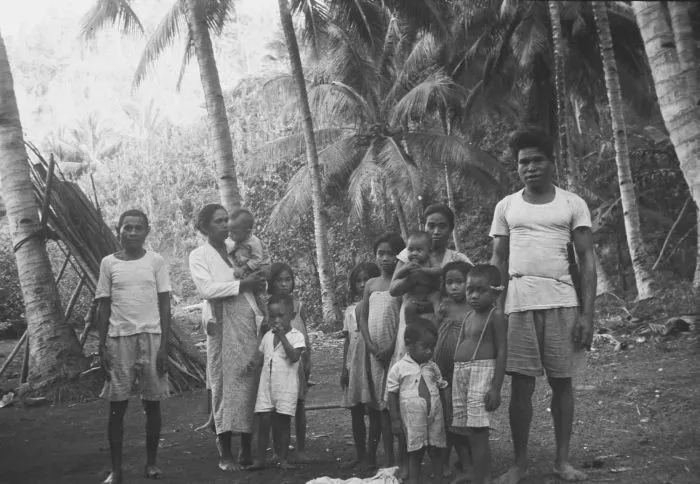
Bitung grew out of a beach where fishermen sheltered. Its port drew Sangihe, Talaud, Gorontalo, Bugis, Javanese, Halmaheran and Chinese-Indonesian families. This is not a Minahasan town that happens to have migrants — it was made of the mixture from the start.
Si Tou Timou Tumou Tou
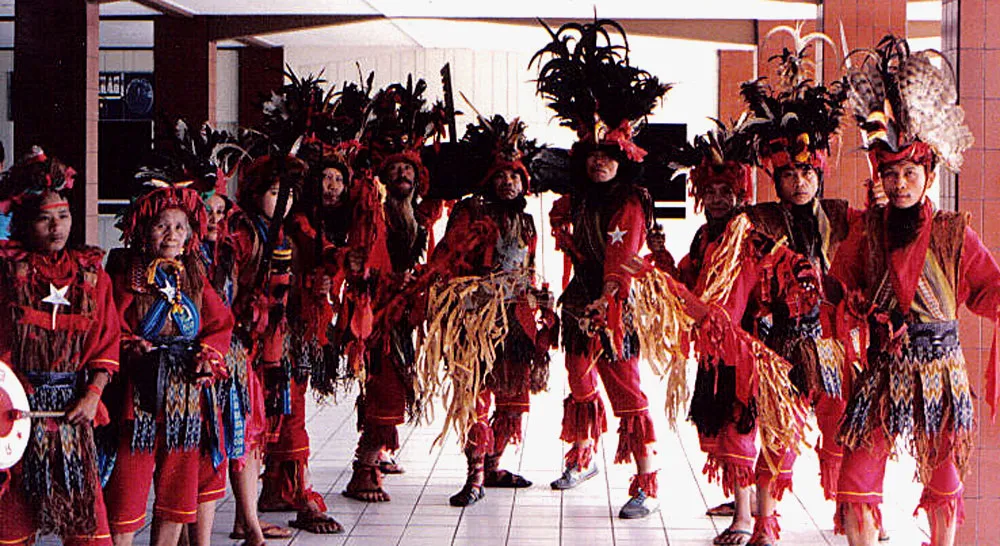
A Tombulu-language maxim popularised by Dr Sam Ratulangi (1890–1949), the Minahasan national hero. It means, roughly: a human being lives to make other human beings human.
Mapalus
The Minahasan system of reciprocal rotating labour. Groups run from two to about fifty members, men and women with equal rights, led by an elected tua impalus. Every role carries its own name — the timekeeper, the enforcer, the allocator of tasks.
The language is not the one in your phrasebook
Everyday speech in Bitung is Manado Malay, a Malay creole with around 850,000 speakers — not standard Indonesian. Its pronouns set a genuine trap: the word you would swear means ‘we’ actually means ‘I’.
A few words
- Kita
- I, me
- Not ‘we’, as it would be in Indonesian
- Torang
- We, us
- As in Torang Samua Basudara
- Ngana
- You
- Borrowed from Ternate
- Mo pi mana?
- Where are you off to?
- An everyday greeting
- Bagus skali
- Very good
- Pastiu
- Bored
- From Portuguese
- Forsa
- Strong
- From Portuguese
- Capeo
- Hat
- From Portuguese
- Forok
- Fork
- From Dutch
- Leper
- Spoon
- From Dutch
Layers inside one language
The word for ‘you’ came from Ternate. The word for fork came from the Dutch. The word for ‘bored’ came from the Portuguese. The language is a chart of every route that ever put in at this shore.
Four hours over smoke
Cakalang fufu is a skipjack tuna split lengthwise without severing the tail, clamped flat between bamboo splints and smoked over burning coconut shell until the flesh turns brick red. The name is completely literal: cakalang means skipjack, fufu means smoked.
- 01
Split
The fish is gutted and descaled, then split in two lengthwise — the tail left joined.
- 02
Clamped
The opened fish is pinned flat in a bamboo frame and rubbed with salt.
- 03
Smoked
About four hours over burning coconut shell, until the flesh turns brick red.
- 04
Cooled
Left to cool. Smoked correctly, cakalang fufu keeps for about a month with no refrigeration at all.
In 2019 the government listed Cakalang Fufu of North Sulawesi as national Intangible Cultural Heritage. In Girian Atas, a few kilometres from here, roughly three-quarters of residents make their living smoking fish — the smoke rises visibly between the rooftops all day.
What you will meet at the table
- Tinutuan
- Manado porridge. The name means ‘all mixed up’: a little rice with pumpkin, tubers such as taro or cassava, and assorted greens. Usually eaten in the morning.
- Dabu-dabu
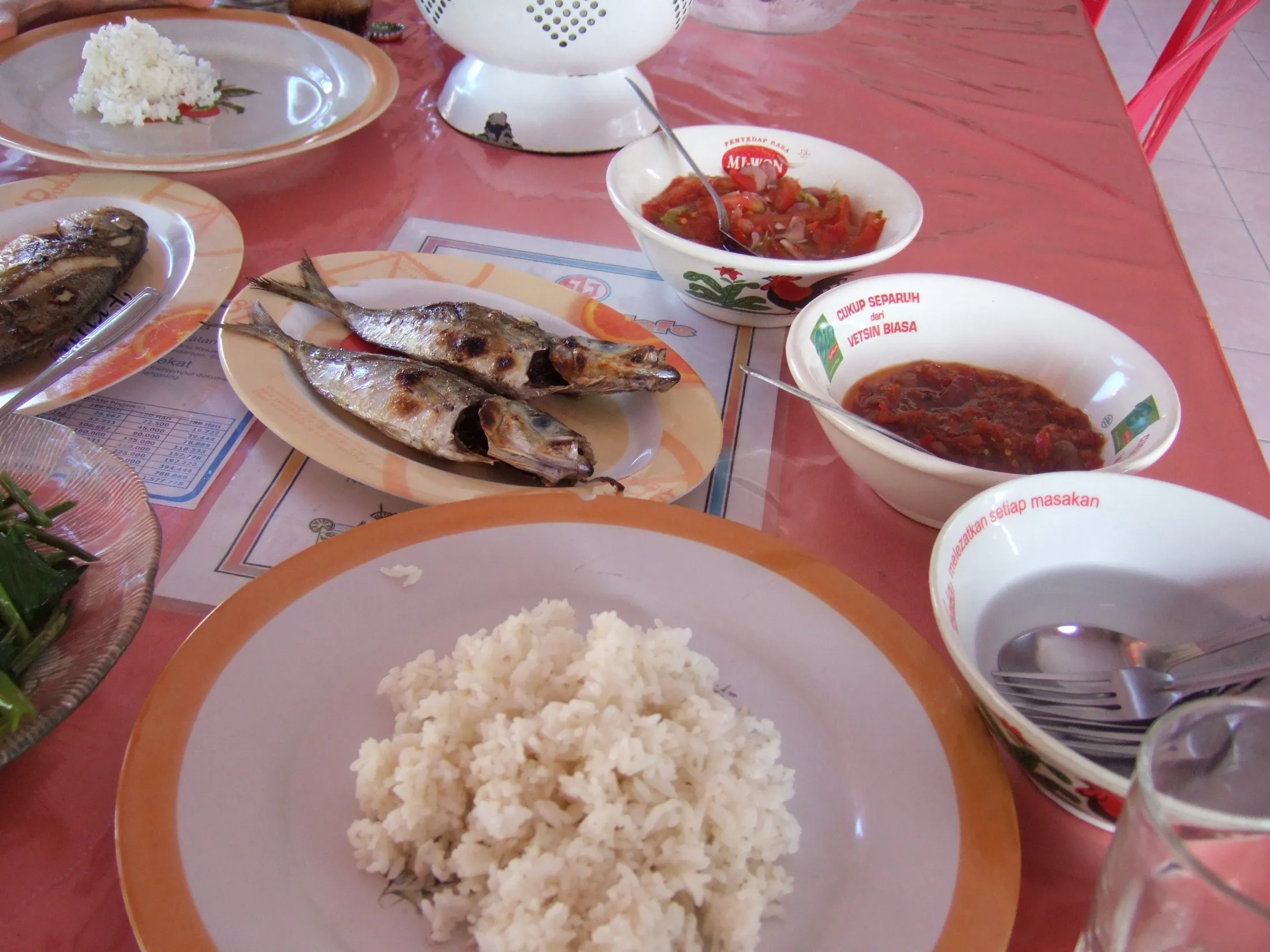
- The raw relish. Everything sliced, nothing ground — dabu-dabu lilang is named after the machete once used to chop it.
- Sambal roa
- Roa — a halfbeak, not a flying fish — smoked bone-dry, then pounded whole, bones included, and fried with chilli.
- Woku
- A yellow, aromatic paste: turmeric, ginger, lemon basil, lime leaf, lemongrass. Woku belanga is cooked in a pot and stays brothy; woku daun is wrapped in daun woka, a fan-palm leaf, and grilled.
- Rica-rica
- The red, fiercely hot chilli paste. ‘Rica’ simply means chilli.
- Mie cakalang
- Yellow wheat noodles with cakalang fufu, served either in broth or fried dry, topped with fried shallots and spring onion. Commonly a breakfast dish.
- Pisang goroho
- A North Sulawesi banana fried deliberately while still green, so it is starchy and savoury rather than sweet. Eaten with sambal roa.
- Nasi jaha
- Glutinous rice with coconut milk, lined with banana leaf, packed into a length of bamboo and roasted over embers.
- Klappertaart
- A Dutch inheritance: klapper (coconut) plus taart (cake). Young coconut flesh folded into a European cake.
- Brenebon
- From the Dutch bruine bonen, brown beans. Usually a soup — and usually made with pork.
- Halua kenari
- Kenari nuts set in caramelised sugar. The standard edible souvenir of North Sulawesi.