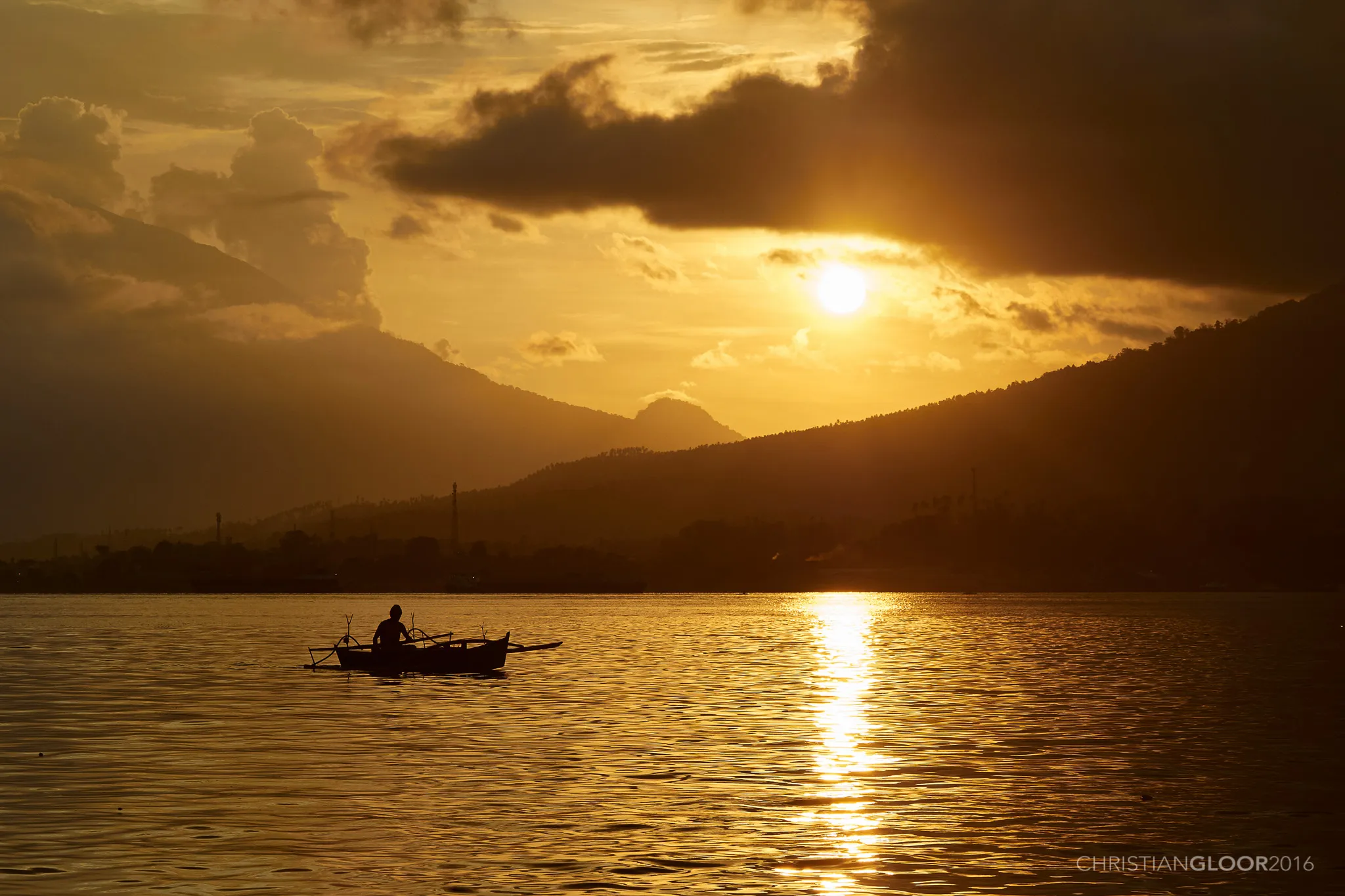
Black sand across the water
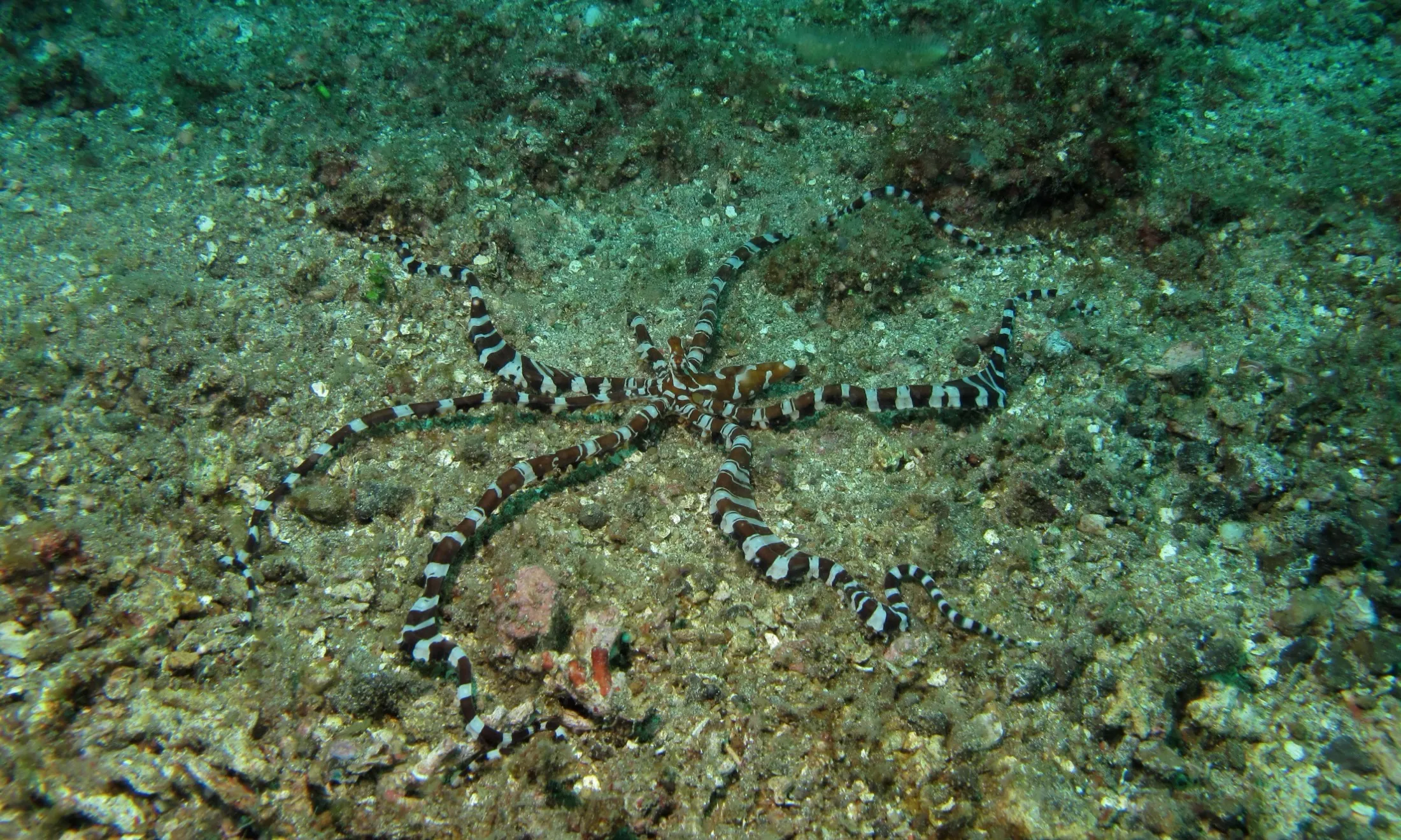
The diving world calls the Lembeh Strait the muck diving capital of the world. Not for its coral — port construction has left the waters of Aertembaga district with no coral reef at all. That is precisely the attraction. Divers travel across the planet to hover over bare black volcanic sand and find a mimic octopus in it.
A section through the strait
What people come for is not the reef but the floor. Black volcanic sand between fifteen and thirty metres down — and the animals that disguise themselves on it.
Black volcanic sand floor — no coral reefThe slopes are drawn as far down as our sources give depths. The floor of the channel itself is recorded nowhere, so it is not drawn. The vertical scale is exaggerated.
Why the sand is black
On the mainland side the sand is black, weathered from the volcanic rock of Tangkoko and Dua Saudara. Around Lembeh Island it runs paler. It is against that dark background that small, superbly camouflaged animals become visible — and famous.
How muck diving was born here
Lembeh’s first dive resort opened in 1994 expecting to show visitors manta rays and dolphins. Within a few years drift nets had emptied the strait of its large animals. So divers looked down instead, at the sand — and found that the small things were far stranger. Larry Smith pioneered diving in this strait from Kungkungan Bay in Kelurahan Tandurusa — the same district as Winenet Dua — and trained the strait’s first generation of dive guides.
What people come to find
- Mimic octopusThaumoctopus mimicus
- WonderpusWunderpus photogenicus
- Blue-ringed octopusHapalochlaena sp.
- Hairy frogfishAntennarius striatus
- Flamboyant cuttlefishMetasepia pfefferi
- Pygmy seahorseHippocampus bargibanti
- Lembeh seadragonKyonemichthys rumengani
The Lembeh seadragon — about 2.7 centimetres long — was described in 2007 and named for Noldy Rumengan, the local dive guide who spotted it. A guide from these waters has his name attached to a species.
Conditions
- Water temperature
- 26–29 °C year round
- Visibility
- 5–15 metres
- Strait length
- About 16 km
- Strait width
- 1–2 km
Diving respectfully
Marine debris is a real and openly acknowledged problem in this strait. Local guides know every site; hiring them is not a formality but the only sensible way to find anything. Never move an animal for a photograph.
Five in the afternoon
The huhate boats — pole and line, one fish at a time — leave the ocean fishing port in this district at around five in the afternoon. Their first destination is not tuna. It is live bait.
- 17:00
Departure
The boat leaves port in the late afternoon. Eight holds are already packed with 300 to 400 blocks of ice — fifteen to twenty tonnes — for a trip that may last only two to six days.
- Night
Buying bait
First stop is other fishermen’s lift-nets and beach seines, to buy live baitfish. Without bait there is no point going out at all.
- Before dawn
Finding the school
Where there is no anchored fish-aggregating device, the skipper reads the sea: diving birds, fish breaking the surface, drifting logs, dolphins, whales.
- Morning
Boiling the sea
Water is sprayed across the surface beside the hull so it looks like a panicking shoal of bait. Two bait-throwers fling live fish from the bow. The skipjack come up one at a time on bamboo poles.
The names aboard
- Nakhoda
- The skipper
- Tonaas
- What the captain is called on a soma pajeko — a Minahasan word for a chief, and also the man who reads the fish
- Juru mudi
- The helmsman
- Juru mesin
- The engineer
- Juru umpan
- Two men, one on each side of the bow, whose entire job is throwing live bait
Sixty-nine per cent of the pole-and-line catch landed at Bitung is skipjack. The rest is yellowfin, tongkol, mahi-mahi and rainbow runner.
A certificate earned here
In March 2020 the Sengkanung Bitung pole-and-line fishers’ association became the first pole-and-line fishery in Indonesia to receive Fair Trade USA certification.
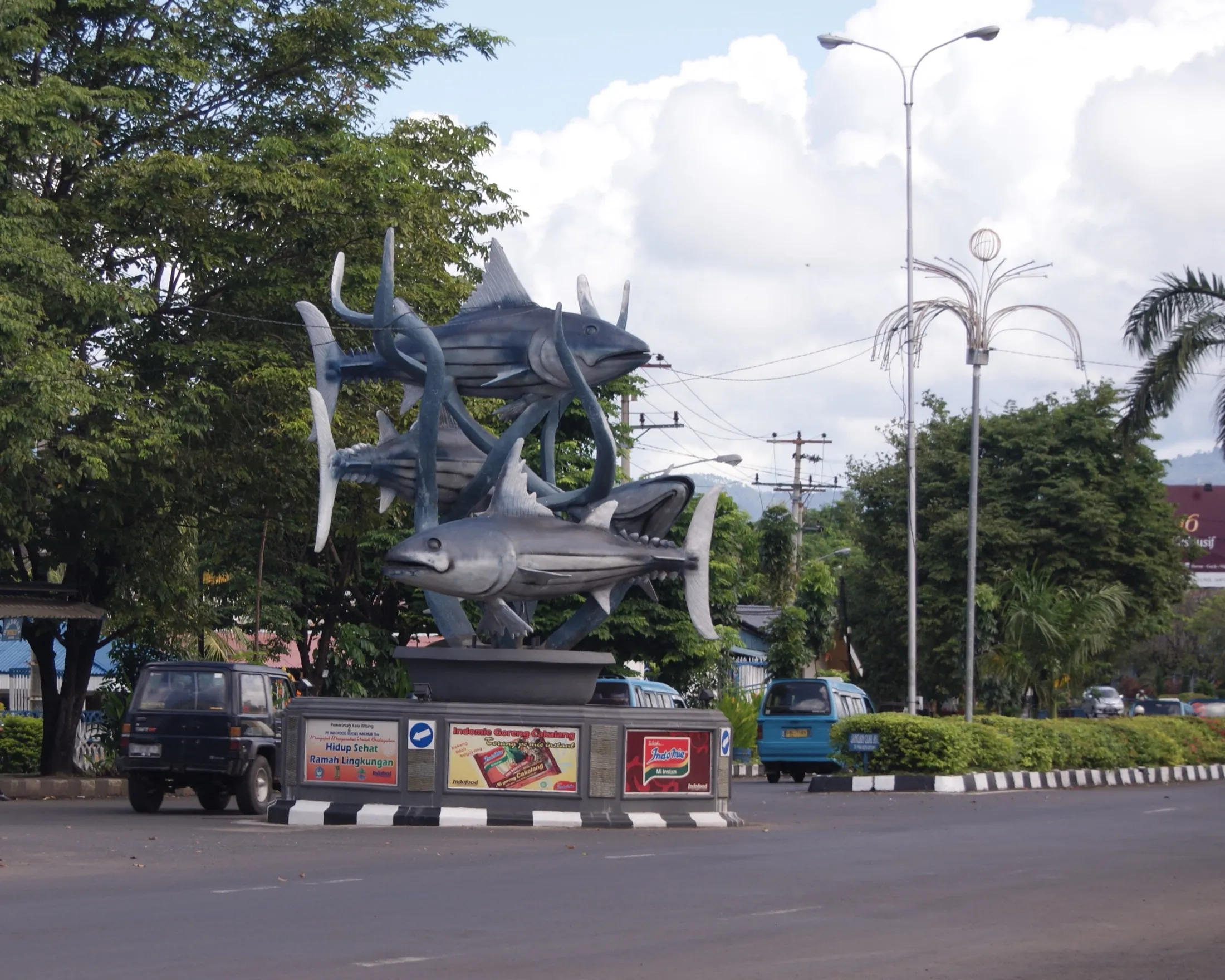
Bitung is nicknamed Kota Cakalang — Skipjack City — and a skipjack statue is its civic landmark. Seven of Indonesia’s fourteen fish canneries are in this one small city, with a combined capacity of around 1,400 tonnes a day.