A short history
Winenet Dua’s own written history is close to non-existent. But the village sits on several hinges — and its city has a record worth remembering.
- c. 1884
Six dotu hold the coast
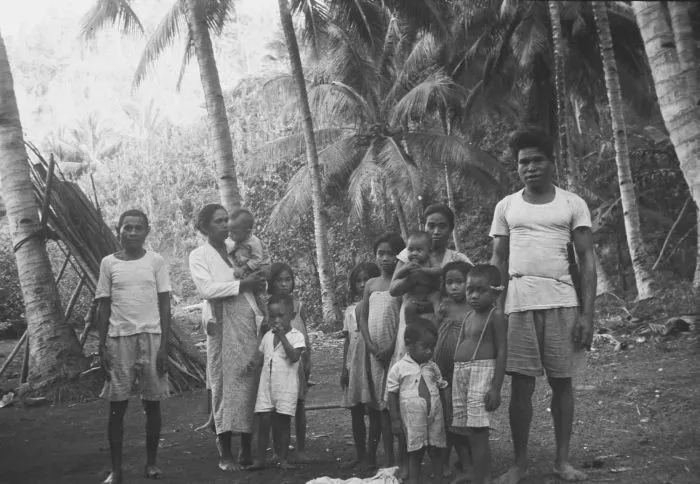
By local tradition the colonial administration, through the head of Tonsea district, recruited six warriors to hold this coast against raiders from Mindanao. One of them was a woman: Magdalena Rotti.
- 1911
Pateten refuses
The Dutch tried to turn Pateten — the village next to Winenet — into a plantation concession. Residents refused, the incoming district head backed them, and the plan collapsed.
- 1918
Bitung recognised
The Dutch East Indies administration recognised Bitung as a negeri on 1 January 1918. By then it had long been a place where fishermen sheltered.
- 1942
Japanese occupation
The Battle of Manado was fought on 11–12 January 1942. The war left two Japanese cargo ships on the floor of the Lembeh Strait — and a Japanese soldiers’ grave in Kelurahan Winenet, about 3 km from the city centre, almost entirely undocumented.
- 1961
Trikora
The Trikora monument stands at Batu Lubang on Lembeh Island. Its measurements are a date: 9 metres long, 12 wide, 61 tall — 9 December 1961.
- 1969
Skipjack becomes industry
Skipjack processing in North Sulawesi came to be centred on Aertembaga — this village’s own district.
- 1975
Indonesia’s first administrative city
By Government Regulation No. 4 of 1975, dated 10 April, Bitung was inaugurated as the first kota administratif in Indonesia.
- 1990
Bitung becomes a city
Bitung was granted full city status on 10 October 1990 — still marked every year as the city’s birthday.
- 1996
This district is created
Established on 6 December 1996 as Kecamatan Bitung Timur, and renamed Aertembaga by regional regulation in 2007.
- 1990s
The strait finds its divers
The first dive resort opened hoping for manta rays. When the big animals vanished, divers looked down at the sand instead — and muck diving was born.
- 2002
The volcano post moves to Winenet
The observation post watching Gunung Tangkoko was relocated to Winenet. Soon afterwards the volcano, silent for 122 years, began to stir.
- 2016
Five thousand people sing
The Lembeh Strait festival staged a mass masamper with around 5,000 singers and a 10K road race with more than 30,000 runners — in a city of roughly 209,000. It was held at the Aertembaga harbour.
- 2017
Flash flood
At 05:00 on 12 February 2017, heavy rain on Gunung Dua Saudara sent floodwater through the district. The disaster agency recorded 120 people from Winenet Dua out of their homes that morning.
- 2022
The toll road arrives
The 39.77 km Manado–Bitung toll road was fully inaugurated on 25 February 2022, cutting the journey from about two hours to under one.
- 2024
Kolintang joins the UNESCO list
On 5 December 2024 UNESCO inscribed kolintang on the Representative List of Intangible Cultural Heritage — not on its own, but through a joint file on ‘Balafon and Kolintang’ submitted by Indonesia together with Mali, Burkina Faso and Côte d’Ivoire.
A year here
The calendar on this coast is set by congregations and festivals rather than by harvests.
- 31 January
Tulude
The Sangihe-Talaud new-year thanksgiving rite. Once held at the end of December, then moved because it sat too close to Christmas. At its centre is the tamo, a tall cone-shaped cake of glutinous rice, palm sugar and coconut, cut and shared out among everyone present. The format changes year to year: in 2024 Bitung’s city government staged it across all eight districts, Aertembaga among them, before a finale at the city hall.
- July–September
Pengucapan Syukur
North Sulawesi’s harvest thanksgiving, descended from the pre-Christian rite Foso Rumages. Its surviving rule is simple: the doors stay open and anyone may come in and eat.
- October–December
Festival Pesona Selat Lembeh
Bitung’s annual festival, grown out of a community-initiated Festival Selat Lembeh that has run since 2009. The dates move — the 2016 edition ran 6–10 October, while the 2024 edition ran 11–13 December. Its signature event is the Sailing Pass: twenty of the ordinary water taxis that ferry people across the strait are painted as floating murals and lead a parade down the channel.
- 10 October
Bitung’s city day
Marking the grant of full city status in 1990.
- Every Sunday
Worship
On Sunday morning the village is quiet and the churches are full. If you want to see Winenet Dua as it sees itself, this is the hour.
The sounds
- Masamper
- The Sangihe-Talaud tradition of competitive call-and-response singing. The name descends from the Dutch zangvereniging, a singing society. One group sings, then hands a flower to their rivals, who must answer.
- Kolintang
- The Minahasan wooden xylophone. On 5 December 2024 UNESCO inscribed it through a joint ‘Balafon and Kolintang’ file, submitted by Indonesia together with Mali, Burkina Faso and Côte d’Ivoire. Its name is simply the sound it makes: tong, ting, tang.
- Kabasaran
- The Minahasan warrior dance, performed in red with a feathered headdress. Dancers must be descended from kabasaran dancers, and the santi sword and wengkouw spear they carry are family heirlooms. It ends in lalaya’an — weapons laid down.
- Maengket
- The Minahasan agricultural-cycle dance, in three parts. The name comes from ‘ma’ (doing) and ‘engket’ (lifting the heels rhythmically).
- Musik bambu & musik bia
- The bamboo orchestra grew out of the susulingan, a small flute farmers played while guarding their gardens. Musik bia is played on blown sea-snail shells — pontuang in Minahasan — and took hold during the Japanese occupation.